



FACIAL SURGERY
Blepharoplasty in Valencia
The Ultimate Guide to Eyelid Surgery with Dr. Alberto Sánchez García
Your eyes are the focal point of non-verbal communication and the facial feature that most quickly reveals fatigue, stress, and the passage of time. Over the years, the delicate skin around the eyes loses elasticity, the orbicularis muscle weakens, and the orbital fat compartments (the dreaded “eye bags”) herniate forward. This creates an appearance of chronic fatigue or sadness that simply does not match how you feel on the inside.
At Alsaga Plastic Surgery, located in the heart of Valencia (Avenida de Francia, 19), Dr. Alberto Sánchez García leads periorbital rejuvenation treatments through blepharoplasty (eyelid surgery or an eyelid lift). This procedure, which combines anatomical precision with a keen aesthetic sense, aims to restore a fresh, youthful appearance to your eyes without altering your natural expressions or eye shape.
This comprehensive medical guide has been designed to provide patients in Valencia, expats across Spain, and medical tourists (mainly from Castellón, Alicante, Cuenca, Teruel, and Albacete) with all the scientific, anatomical, and practical information regarding blepharoplasty. It serves as the definitive resource before taking the step toward facial plastic surgery. If you are looking for the best board-certified plastic surgeon in Valencia for your eyelid surgery, this information will help you make an informed decision.
What is Blepharoplasty?
Blepharoplasty is the surgical procedure designed to correct defects in the upper and lower eyelids. It involves the resection (removal) of redundant skin, the remodeling or trimming of hypertrophic orbicularis muscle, and the extraction or repositioning of excess orbital fat.
The main objective is not to artificially “pull” or “stretch” the eye, but to relieve it from the visual weight that ages it. When performed by a top-tier, board-certified plastic surgeon like Dr. Alberto Sánchez García, blepharoplasty is one of the cosmetic surgeries with the highest patient satisfaction rates. It offers long-lasting results, practically invisible scars, and a highly tolerable, quick recovery period.
Indications for Blepharoplasty in Valencia: Is this surgery right for you?
By Dr. Alberto Sánchez García, your plastic surgeon in Valencia.
Eyelid surgery is indicated for both aesthetic and functional reasons. Ideal candidates are men and women, generally 35 years of age and older (although genetics can cause eye bags to appear as early as your twenties), who exhibit one or more of the following signs:
"Hooded" Upper Eyelids (Dermatochalasis)
Excess skin drooping over the natural fold of the eye, which in severe cases can even impair your peripheral vision.
Lower Under-Eye Bags
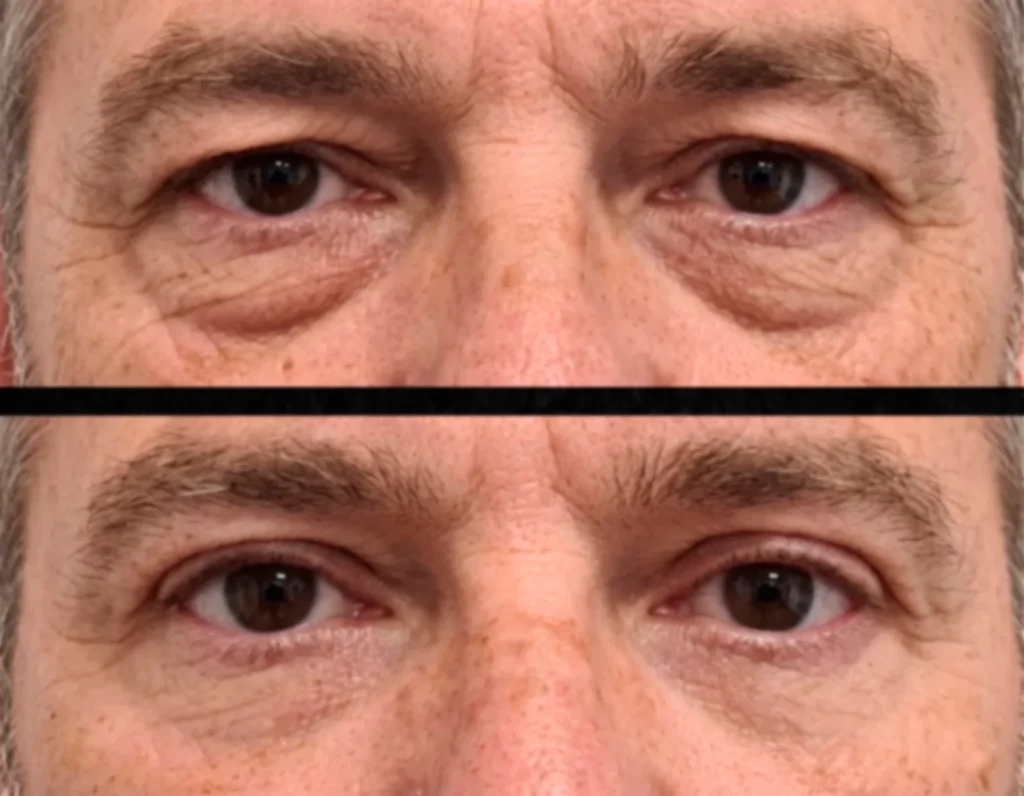
Permanent puffiness or bulging under the eyes that does not improve with sleep or rest, caused by the herniation of periorbital fat.
Permanently Tired Look
A feeling of heaviness in the eyes, especially at the end of the day.
Muscle Laxity
Loss of tone in the orbicularis muscle, which can cause additional wrinkles and folds beneath the eye.
Eyelid Asymmetries
Noticeable differences in the size of the eye opening or the height of the eyelid crease.
Relative contraindications: Patients with severe dry eye syndrome, uncontrolled glaucoma, or unmanaged thyroid eye diseases (such as Graves’ ophthalmopathy). During his plastic surgery consultation in Valencia, Dr. Alberto Sánchez García (Alsaga Plastic Surgery) performs a thorough anatomical evaluation to guarantee maximum safety for every patient.
Periorbital Anatomy and Technical Details
To understand the success of a modern blepharoplasty, it is vital to comprehend the complex anatomy of the area. It is no longer about indiscriminately “removing skin and fat” (older techniques that often left patients with hollowed or skeletal eyes), but about repositioning and preserving anatomical volumes.
Key structures in the intervention:
Eyelid Skin
This is the thinnest skin on the human body (barely 0.5 mm thick). This is a surgical advantage, as it heals exceptionally well and fast, leaving minimal scarring.
Orbicularis Oculi Muscle
The sphincter muscle that closes the eye. In upper blepharoplasty, a thin strip is sometimes removed to deepen the eyelid crease. In the lower eyelid, it is fundamental to preserve it and even tighten it (canthopexy/canthoplasty) to provide support to the eyelid.
The Orbital Septum
A thin fibrous membrane that holds the orbital fat within the eye socket. With age, the septum weakens, allowing fat to protrude.
Fat Compartments (Bags)
- Upper Eyelid: Has 2 fat compartments (central and medial/inner). The inner fat is usually paler and denser.
- Lower Eyelid: Has 3 compartments (medial, central, and lateral/outer).
- Lower Eyelid: Has 3 compartments (medial, central, and lateral/outer).
Dr. Sánchez García’s approach in Valencia prioritizes tissue preservation. Often, instead of simply removing lower eye bags, the fat is transposed (slid over) into the tear trough to fill in the hollows, achieving a smooth, youthful transition between the eyelid and the cheek.
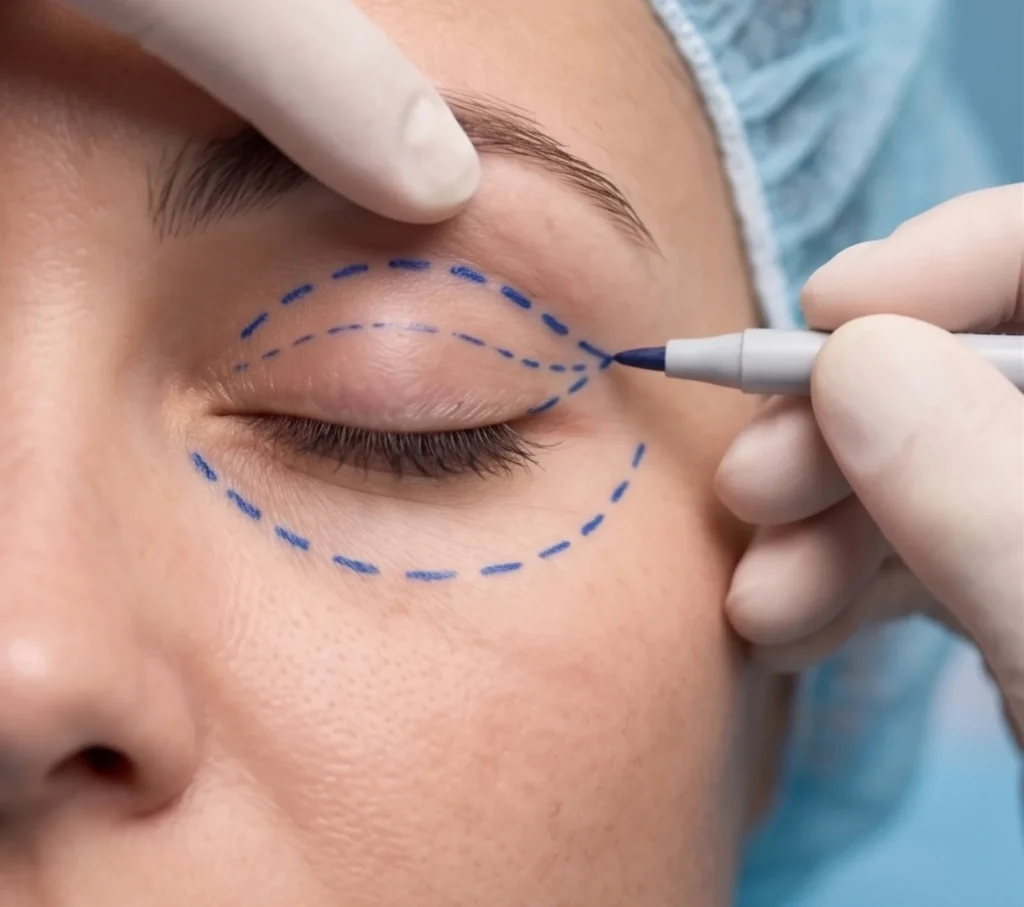
Types of Blepharoplasty
At Alsaga Plastic Surgery, the intervention is meticulously tailored to the exact anatomical needs of the patient.
Upper Blepharoplasty (Upper Eyelid Lift)
Focuses on rejuvenating the top eyelid. The surgeon designs a spindle-shaped incision that remains perfectly hidden in the natural crease of the eyelid when the eye is open. Excess skin (dermatochalasis) is removed, along with a small portion of the inner fat pad if necessary.
- Duration: 45 - 60 minutes.
- Anaesthesia: Local, with or without sedation.
- Duration: 45 - 60 minutes.
- Anaesthesia: Local, with or without sedation.
Lower Blepharoplasty (Lower Eye Bag Removal)
Aims to remove or reposition the fat bags of the lower eyelids and treat skin laxity. It is technically more demanding than the upper surgery. Depending on whether there is excess skin or not, a different surgical approach will be chosen (transconjunctival or transcutaneous).
- Duration: 1 - 1.5 hours.
- Anaesthesia: Local with IV sedation or light general anesthesia.
- Duration: 1 - 1.5 hours.
- Anaesthesia: Local with IV sedation or light general anesthesia.
Complete Blepharoplasty (Quad Blepharoplasty)
This is the combined intervention of both upper and lower eyelids (all four eyelids). It is the most requested periorbital facial rejuvenation procedure in Valencia due to its comprehensive, transformative results.
- Duration: 2 - 2.5 hours.
- Anaesthesia: Local with deep sedation or short general anesthesia.
- Duration: 2 - 2.5 hours.
- Anaesthesia: Local with deep sedation or short general anesthesia.
Asian Blepharoplasty (Double Eyelid Surgery)
Indicated for patients of Asian descent who lack a supratarsal crease (the natural upper eyelid fold). A permanent crease is created by anchoring the skin to the levator muscle aponeurosis.
Secondary Blepharoplasty (Revision Eyelid Surgery)
Designed to correct complications or unsatisfactory results from previous surgeries performed at other clinics (e.g., eyelid retraction, "round eye," or excessive skin removal). This is a highly complex reconstructive surgery requiring an individualized assessment by Dr. Alberto Sánchez García.
Types of Lower Eyelid Approaches
One of the most critical decisions made during the consultation is how to access the lower fat pads. There are two primary techniques:
Transconjunctival Approach (Scarless Eye Bag Removal)
The incision is made inside the lower eyelid, through the conjunctiva.
- Advantages: No external visible scar on the skin. The orbicularis muscle is not altered, making the risk of eyelid retraction (ectropion) practically zero. The recovery is extremely fast.
- Indication: Younger or middle-aged patients who have fat bags but no excess flaccid skin on the lower eyelid.
Transcutaneous / Subciliary Approach
The incision is made just 1 or 2 millimeters below the lower lash line, extending slightly outward into the “crow’s feet” area.
- Advantages: Allows the surgeon to extract excess fat and, at the same time, trim and tighten redundant skin.
- Indication: Older patients who, in addition to eye bags, present significant skin laxity and marked wrinkles (festoons) under the eyes. To prevent the eyelid from drooping after surgery, Dr. Sánchez García often combines this with a canthopexy (anchoring the outer corner of the eye to the orbital bone) for added support and tension.

Initial Assessment and Marking: Surgery Day.
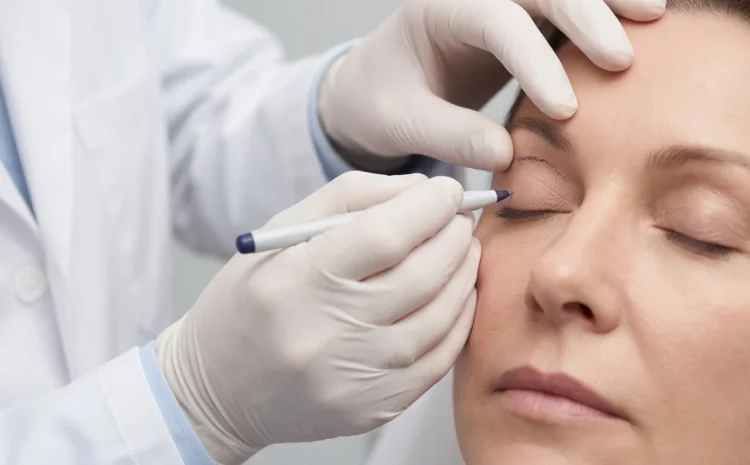
Dr. Alberto Sánchez García makes precise, millimeter-accurate markings on the eyelid skin while the patient is seated, determining the exact amount of skin to resect and identifying the natural folds that will hide the incisions.
Anesthesia and Monitoring: Operating Room.
Under the care of our expert anaesthesiology team in our Valencia facilities, local anaesthesia is administered, often paired with intravenous sedation (or light general anaesthesia), ensuring complete comfort with no pain or memory of the procedure.
Surgical Technique: Tissue Management.
Incisions are made (using a micro-scalpel or high-precision electric/laser scalpel to minimize bleeding). Redundant skin is removed, meticulous hemostasis is achieved, and fat bags are extracted or transposed according to the anatomical plan.
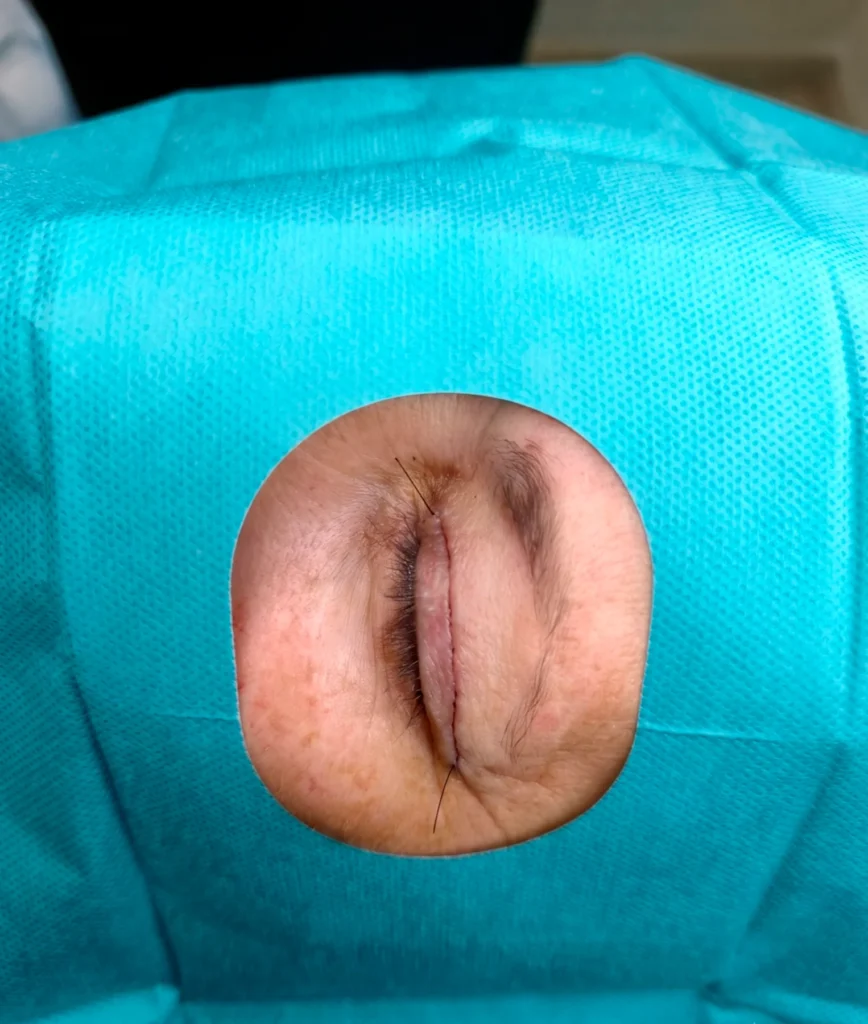
Suturing and Closure: Invisibility.
The incisions are closed with sutures finer than a human hair (6/0 caliber). In the lower transconjunctival approach, the internal incision usually requires no stitches at all, as the mucosa heals naturally on its own.
Immediate Recovery: the first 48 hours.
Constant application of local cold therapy (ice or gel masks) to control swelling and prevent bruising. You must sleep with your head elevated (2-3 pillows). It is normal to experience slightly blurred vision due to the protective ophthalmic ointment used.
Suture Removal: Days 5 to 7.
A quick visit to our Plastic Surgery clinic in Valencia to have the stitches removed painlessly. You can then return to your normal social and work life.
Frequently Asked Questions (FAQ) about Blepharoplasty in Valencia
Answered by Dr. Alberto Sánchez García, your plastic surgeon in Valencia.
To ensure this remains the most comprehensive guide to eyelid surgery, we have compiled and answered the most common questions our patients ask us (both in-person and via video consultation) before undergoing blepharoplasty in Valencia.
What is a blepharoplasty?
It is the cosmetic and reconstructive surgery of the eyelids that removes excess skin, muscle, and orbital fat to rejuvenate the gaze and, sometimes, improve the peripheral field of vision.
What is the cost of a blepharoplasty in Valencia?
The price varies depending on whether it is an upper, lower, or complete blepharoplasty, the specific techniques required (like fat transposition or canthopexy), and operating room fees. At Alsaga Plastic Surgery, we offer a finalized, transparent quote after your first in-person anatomical evaluation.
Average prices in Valencia are:
- Upper blepharoplasty: From €1,500
- Lower blepharoplasty: From €2,200
- Full blepharoplasty (general anesthesia): From €4,000
- Direct brow tail lift: From €1,500
- Full blepharoplasty + facial lipofilling: From €4,500
Average prices in Valencia are:
- Upper blepharoplasty: From €1,500
- Lower blepharoplasty: From €2,200
- Full blepharoplasty (general anesthesia): From €4,000
- Direct brow tail lift: From €1,500
- Full blepharoplasty + facial lipofilling: From €4,500
What is a transconjunctival blepharoplasty?
It is a technique used to operate on the lower eyelid without cutting the skin. Fat pads are accessed by making an incision on the inside of the eyelid (the conjunctiva), leaving no visible external scar and reducing the risk of altering the eye’s shape.
How long does eyelid surgery in Valencia take on average?
It depends on the extent of the surgery. Upper eyelids take about 45-60 minutes. A complete quad blepharoplasty (all 4 eyelids) takes about 2 hours in the operating room.
Is general or local anaesthesia used?
For an isolated upper blepharoplasty, local anaesthesia is usually sufficient. If lower eyelids or all four are being operated on, Dr. Sánchez García prefers to add intravenous sedation or use light general anaesthesia for maximum patient comfort and surgical precision.
Is laser better than a traditional scalpel?
The use of a CO2 laser, radiofrequency scalpel, or cold scalpel is largely a matter of surgeon preference. Lasers and radiofrequency cauterize blood vessels as they cut, reducing bruising; however, it is the plastic surgeon's skill and technique (how they handle fat and preserve muscle) that determine the final result, not the cutting tool. Even so, we offer both options and will gladly explain the pros and cons of each to you.
What are the differences between upper and lower blepharoplasty?
Upper blepharoplasty treats excess, drooping skin that falls over the eye (hooding). Lower blepharoplasty primarily targets fat bags under the eyes and lower eyelid laxity. They can be performed separately or together.
Will blepharoplasty change the shape of my eyes?
It should not. A well-executed blepharoplasty rejuvenates the eyes without altering your facial features. If eyes appear "rounded" or asymmetrical post-surgery, it is usually due to an over-resection of lower eyelid skin—something Dr. Alberto Sánchez actively avoids by using conservative techniques and support structures (canthopexy).
Does blepharoplasty get rid of dark circles?
The surgery removes the volume (bags) and brightens the area by eliminating shadows. However, there are specific surgical (like facial lipofilling/fat grafting) and non-surgical procedures that can further improve pigmentation in this area. Ask about these during your consultation at our plastic surgery clinic in Valencia.
Can this surgery eliminate "crow's feet"?
Not directly. Blepharoplasty removes excess skin from the eyelids, but it does not stop the underlying muscle movement that causes lateral expression wrinkles. For crow's feet, the treatment of choice is neuromodulators (Botox).
Is the recovery from blepharoplasty in Valencia painful?
Surprisingly, no. It has one of the least painful recoveries in cosmetic surgery. Patients report a feeling of tightness, heaviness, or mild stinging, which is perfectly controlled with common painkillers like paracetamol. Acute pain is rare and should be reported to us immediately.
How much time off work do I need?
For office jobs, the majority of Alsaga Plastic Surgery patients return to work between days 5 and 7 post-op (right after stitch removal). For highly intensive physical jobs, 14 days are recommended.
When will I see the final results?
Subtle swelling from this intervention takes a few weeks to fully subside. The optimal, definitive result is best evaluated around the 6-month mark.
Are there visible scars?
Scars on the upper eyelids are perfectly hidden in the natural crease of the eye. Scars on the lower eyelids (if transcutaneous) are hidden just below the lash line. After a few months, they become thin white lines that are virtually imperceptible to the naked eye.
How do I wash my eyes in the first few days?
You will be instructed to gently wash your eyes with cold physiological saline and soft sterile gauze, without rubbing. Additionally, you will apply antibiotic eye ointments and lubricating drops to keep your corneas hydrated.
How should I sleep after surgery?
During the first week, we recommend sleeping on your back with the head of your bed elevated at a 30 to 45-degree angle (using a couple of pillows). Thanks to gravity, this drastically reduces edema and swelling.
When can I wear makeup again?
Face makeup can be applied starting on the third day, but for eyelid or eye-specific makeup (mascara, eyeshadow) over the incisions, you must wait at least 10 to 14 days, following Dr. Sánchez García's direct approval.
When can I return to sports?
Light walking is encouraged from day one. High-impact sports (running, weightlifting, tennis) should be paused for 3 to 4 weeks to avoid spikes in blood pressure that could trigger delayed bleeding.
What is dry eye syndrome, and how does it affect surgery?
It is a condition where the eye does not produce enough high-quality tears. Blepharoplasty temporarily alters blinking dynamics, which can transiently worsen dry eyes. This is why we prescribe artificial tears during the first few weeks. If you suffer from severe pre-existing dry eye, we will carefully evaluate whether you are a suitable candidate for surgery.
What happens if my eyes don't close completely after surgery?
This is called lagophthalmos. It is very common during the first 2-3 days due to tissue swelling and tightness. It is managed by applying the lubricating gels we provide immediately after surgery and resolves spontaneously. Permanent lagophthalmos is a very rare complication caused by an overly aggressive skin resection technique, which we prevent through meticulous pre-operative measurements.
If I get a blepharoplasty in Valencia, do I need to have stitches removed?
For most upper blepharoplasties and subciliary lower approaches, yes; they are removed between days 5 and 7. It is a quick, painless process. For the transconjunctival approach, we frequently use dissolvable stitches (or no sutures at all) that vanish on their own.
Does smoking affect recovery?
Absolutely. Nicotine constricts blood vessels and severely delays healing, increasing the risk of necrosis or thickened scars. It is imperative that you stop smoking (including nicotine vapes) at least 2 weeks before and 2 weeks after the procedure.
Can I sunbathe after my eyelid surgery?
No. Direct sun exposure is strictly forbidden while you still have swelling or bruising, as UV rays could permanently hyper-pigment the skin (known as "hemosiderin staining" or "hemosiderin tattooing"). Once the bruises fade, you must use SPF 50+ sunscreen and wear sunglasses during peak sun hours.
At what age is it recommended to get eyelid surgery in Valencia?
There is no "correct" age. Most of our patients in Valencia are between 45 and 65 years old, but we regularly treat 25-year-old patients who, due to family genetics, have pronounced lower eye bags from youth. In these cases, we perform early transconjunctival interventions (or address familial upper eyelid hooding).
Are the results permanent?
The fat that is removed or repositioned rarely comes back; in that sense, the result is highly permanent. However, the natural skin aging process continues. Generally, the rejuvenating effects last between 10 and 15 years. Many people only need this surgery once in their lifetime.
Can I get eyelid surgery if I have myopia, astigmatism, or glaucoma?
Myopia and astigmatism are not issues (though you will need to wear glasses instead of contact lenses for 2 weeks post-surgery). Glaucoma must be rigorously controlled and cleared by your ophthalmologist, as surgical inflammation can temporarily alter intraocular pressure.
Can blepharoplasty be combined with a facelift or rhinoplasty?
Yes, it is incredibly common. Blepharoplasty is frequently paired with a face and neck lift, facial fat grafting (lipofilling), or a brow lift during the same surgical session. This achieves a comprehensive facial rejuvenation with only one recovery period.
What are the risks of the intervention?
Like any surgical procedure, it carries general risks associated with anaesthesia, infection (which is very rare in eyelids due to high vascularization), or bleeding. Specific complications like ectropion (where the lower eyelid pulls outward) are effectively avoided by employing secure suspension techniques and preserving the orbicularis muscle under the strict technical guidelines of Dr. Alberto Sánchez García.
Why choose Dr. Alberto Sánchez García and Alsaga Plastic Surgery in Valencia?
Choosing the right professional is the single most important factor for success. Dr. Alberto Sánchez García combines an impeccable anatomical background as a reconstructive and aesthetic plastic surgeon with an artistic vision focused on natural results. At Alsaga, we do not franchise health: you are accompanied by the same top-tier surgeon from your very first consultation, into the operating room, and through your final medical discharge, utilizing certified operating rooms and premier European safety protocols.
The medical information contained in this article is for educational purposes and does not, under any circumstances, replace a face-to-face consultation with our board-certified plastic surgeon. Request an appointment today, and let’s talk.
Regain Control of Your Gaze
Your eyes are your introduction to the world. If, when you look in the mirror, you feel that your eyelids reflect a fatigue that does not truly represent who you are, modern science and surgical expertise now offer a definitive, safe, and natural-looking solution.
If you are in Valencia, living in Spain as an expat, or considering medical travel, and desire an honest, anatomical, and personalized evaluation of your case, Dr. Alberto Sánchez García and his team at Alsaga Plastic Surgery are at your full disposal. Because of the quick recovery, this is an ideal procedure for patients traveling from anywhere in Spain or abroad, allowing you to return home safely and swiftly.